Variable: GtkStack
constGtkStack:"GtkStack"
Defined in: generated/jsx.ts:19792
Shows one of its children at a time.
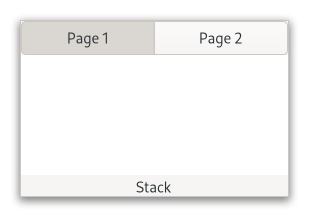
In contrast to GtkNotebook, GtkStack does not provide a means
for users to change the visible child. Instead, a separate widget
such as Gtk.StackSwitcher or Gtk.StackSidebar can
be used with GtkStack to provide this functionality.
Transitions between pages can be animated as slides or fades. This can be controlled with Gtk.Stack.set_transition_type. These animations respect the Gtk.Settings.gtk-enable-animations setting.
GtkStack maintains a Gtk.StackPage object for each added
child, which holds additional per-child properties. You
obtain the GtkStackPage for a child with Gtk.Stack.get_page
and you can obtain a GtkSelectionModel containing all the pages
with Gtk.Stack.get_pages.
GtkStack as GtkBuildable
To set child-specific properties in a .ui file, create GtkStackPage
objects explicitly, and set the child widget as a property on it:
  <object class="GtkStack" id="stack">
    <child>
      <object class="GtkStackPage">
        <property name="name">page1</property>
        <property name="title">In the beginning…</property>
        <property name="child">
          <object class="GtkLabel">
            <property name="label">It was dark</property>
          </object>
        </property>
      </object>
    </child>
CSS nodes
GtkStack has a single CSS node named stack.
Accessibility
GtkStack uses the Gtk.AccessibleRole.tab_panel role for the stack
pages, which are the accessible parent objects of the child widgets.